01
Hypnotherapy
Evidence-based for trauma, anxiety, pain, and performance blocks.
Hypnotherapy is recognized by the American Psychological Association (Division 30) and supported across multiple large-scale meta-analyses and Cochrane reviews. Research shows measurable acceleration of trauma reprocessing, rapid downshift of elevated sympathetic arousal, and durable change in automatic response patterns — making it one of the foundational tools for clearing the survival program and installing the Alpha flow state wiring the rest of the protocol depends on.
02
Neuro-Linguistic Programming (NLP)
Re-pattern the subjective experience driving automatic responses.
Modern applied research — including reviews by Tosey, Mathison and Davy, applied trauma work by Heimbürger et al., and Sturt et al. on phobia and anxiety — supports NLP's clinical utility for performance blocks, presentation anxiety, and trauma reactivity. Inside Alpha Imprinting, NLP is used to map and rewrite the subjective experience that drives automatic output, so the new nervous-system wiring fires under pressure, not only in session.
03
Somatic Experiencing®
Trauma release through interoceptive awareness and titration.
Developed by Dr. Peter Levine, Somatic Experiencing has been evaluated in RAND Corporation trials (2018, 2020) and in independent clinical studies showing measurable reductions in PTSD symptom severity, improved sleep architecture, and improved autonomic regulation. SE is the modality that lets the body complete the survival response it could not finish in the original moment — and stop holding the charge that was running the defended set point and the trauma-driven sympathetic lock.
04
Frequency Medicine
Vibrational inputs that entrain brainwave state and autonomic regulation.
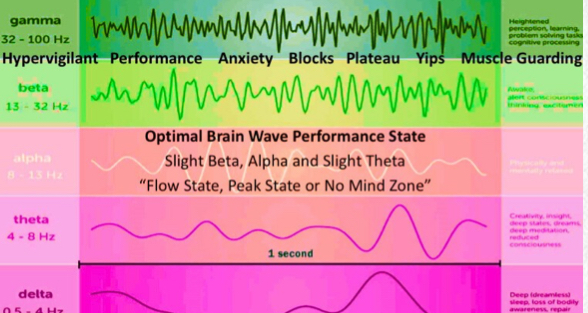
Binaural beat, vibroacoustic, and tonal protocols have been studied for their effect on brainwave entrainment (notably the 40 Hz gamma band, which has been linked to cognitive binding and memory consolidation) and for measurable improvements in heart rate variability, cortisol regulation, and reported relaxation. Inside Alpha Imprinting, frequency medicine amplifies the state shift and supports reprogramming at the energy-medicine level — including the Solfeggio framework detailed below.
05
Brainspotting
Eye-position-based subcortical processing of unresolved trauma.
Developed by Dr. David Grand, Brainspotting uses the field of view to identify and process subcortical regions where trauma and performance residue are stored. Case-study and emerging clinical literature reports reductions in trauma activation, somatic distress and performance blocks — including improvements in athletes and high performers carrying blocked, high-output stress loads. Within Alpha Imprinting, it is used as a precision tool for residue other modalities cannot reach.
06
EFT Tapping Matrix Reimprinting
Acupoint-based meridian interruption paired with Matrix Reimprinting.
EFT has the largest empirical base of any tapping-based intervention, including Church's 2018 systematic review of more than 100 studies, randomized controlled work showing significant cortisol reduction, and a 2013 study on combat veterans documenting meaningful PTSD symptom reduction. Matrix Reimprinting, developed by Karl Dawson, layers targeted re-patterning of childhood and adverse memories into the meridian work. In Alpha Imprinting, the pairing is used to clear the charge on life-altering memories and rewrite the early imprint the survival program is still defending — including the ones running the defended set point.
07
EMDR (Eye Movement Desensitization and Reprocessing)
Bilateral stimulation to reprocess stored trauma and performance residue.
Developed by Dr. Francine Shapiro, EMDR is endorsed by the American Psychological Association, the World Health Organization, the International Society for Traumatic Stress Studies, and the U.S. Departments of Veterans Affairs and Defense as an evidence-based treatment for PTSD and trauma-spectrum presentations. A substantial body of randomized controlled trials and meta-analyses supports its use for performance blocks, anxiety, and resolution of disturbing sport-related memories. Bilateral stimulation (visual, tactile, or auditory) is paired with targeted attention to activate the brain's adaptive information-processing system — allowing the survival charge to discharge and the memory to be stored without hijacking the present. Inside Alpha Imprinting, EMDR is used as a faster-acting layer for discrete trauma imprints and performance-event residue, freeing capacity for the deeper subconscious rewiring the rest of the protocol depends on.
08
Visualization & Sports Imagery
Cognitive rehearsal that activates the same neural pathways as physical execution.
Sports imagery and visualization research — including reviews by Weinberg (2008), Cumming (2008), and the Morris, Spittle and Watt (2005) meta-analysis — shows measurable gains in motor performance, confidence, anxiety reduction, and motor-skill acquisition when imagery is structured systematically. Functional MRI work demonstrates that imagined movement activates overlapping cortical and subcortical regions with actual execution, making imagery a low-load, high-repetition form of training — particularly valuable in injury return-to-play and in refining the sport-specific micro-movements installed during the Reimprint phase. Within Alpha Imprinting, structured visualization is used as the conscious rehearsal step that bridges the new subconscious programming into real, repeatable performance under pressure.
09
Psychological Sigh Breathwork
Double inhale through the nose, long exhale — the fastest real-time reset of the sympathetic response.
The physiological sigh — a double inhale through the nose followed by an extended exhale — was characterized in the Balban et al. (2023) randomized controlled trial published in Cell Reports Medicine from the Stanford Huberman laboratory. Across multiple stress-induction paradigms, the physiological sigh produced the largest and most rapid reduction in physiological arousal and self-reported anxiety compared with box breathing, cyclic sighing, and mindfulness meditation, and outperformed the other protocols on sleep quality and resting-state parasympathetic markers in extended practice. Inside Alpha Imprinting, the physiological sigh is the in-session and pre-competition tool used to interrupt a triggered sympathetic lock in real time — clearing the breathing-pattern disruption the survival program installs — so the new nervous-system wiring can be rehearsed without the body fighting it.
10
Functional Neurology Exercises
Brain-based receptor, vestibular, and ocular drills that drive neuroplastic change at the source.
Functional neurology applies receptor-driven stimulation — vestibular, oculomotor, proprioceptive, hemicranial, and cerebellar drills — to drive measurable neuroplastic change in targeted brain regions. The practitioner field is associated with the work of Dr. Frederick Carrick and the Carrick Institute, and has growing applied literature supporting its use for concussion recovery, balance and vestibular retraining, oculomotor performance, post-injury return-to-play protocols, and peak-performance activation in elite athletes. Excellent safety and tolerability make it an ideal partner modality. Within Alpha Imprinting, functional neurology exercises are used between sessions to reinforce the neurological change at the receptor level — strengthening the brain regions the Reimprint phase is rewiring, so the new programming is metabolically supported, not only psychologically rehearsed.
11
Mindfulness Meditation
Present-moment attention training that holds the Alpha Imprinting windows open between modalities.
Mindfulness-based interventions have a substantial evidence base — including the Khoury et al. (2013) meta-analysis of 209 studies showing moderate-to-large effect sizes for stress, anxiety, depression, and pain, and the Goyal et al. (2014) JAMA Internal Medicine review of 47 trials with documented gains in those same domains. fMRI work on experienced meditators shows reduced amygdala reactivity and improved prefrontal regulation — the neural signature of a nervous system that can drop out of the defended set point on demand. Within Alpha Imprinting, mindfulness meditation is the receptive-state floor that holds the windows open between modalities: the capacity to stay present, observe the body’s signals without defending against them, and let the new programming land without the survival program reasserting itself.