The case for the work

Why optimize.

Most athletes — and the high performers living by the same rules: founders, executives, surgeons, first responders, creatives — don't know the inner game can be reprogrammed — and most performance issues aren't willpower, mindset, or talent. They're a trauma response wired into the subconscious, running silently underneath every game.

This page walks you through how trauma responses develop, how they take over performance, and how Alpha Imprinting clears the reservoir — so the nervous system can return to Alpha flow and stay there.

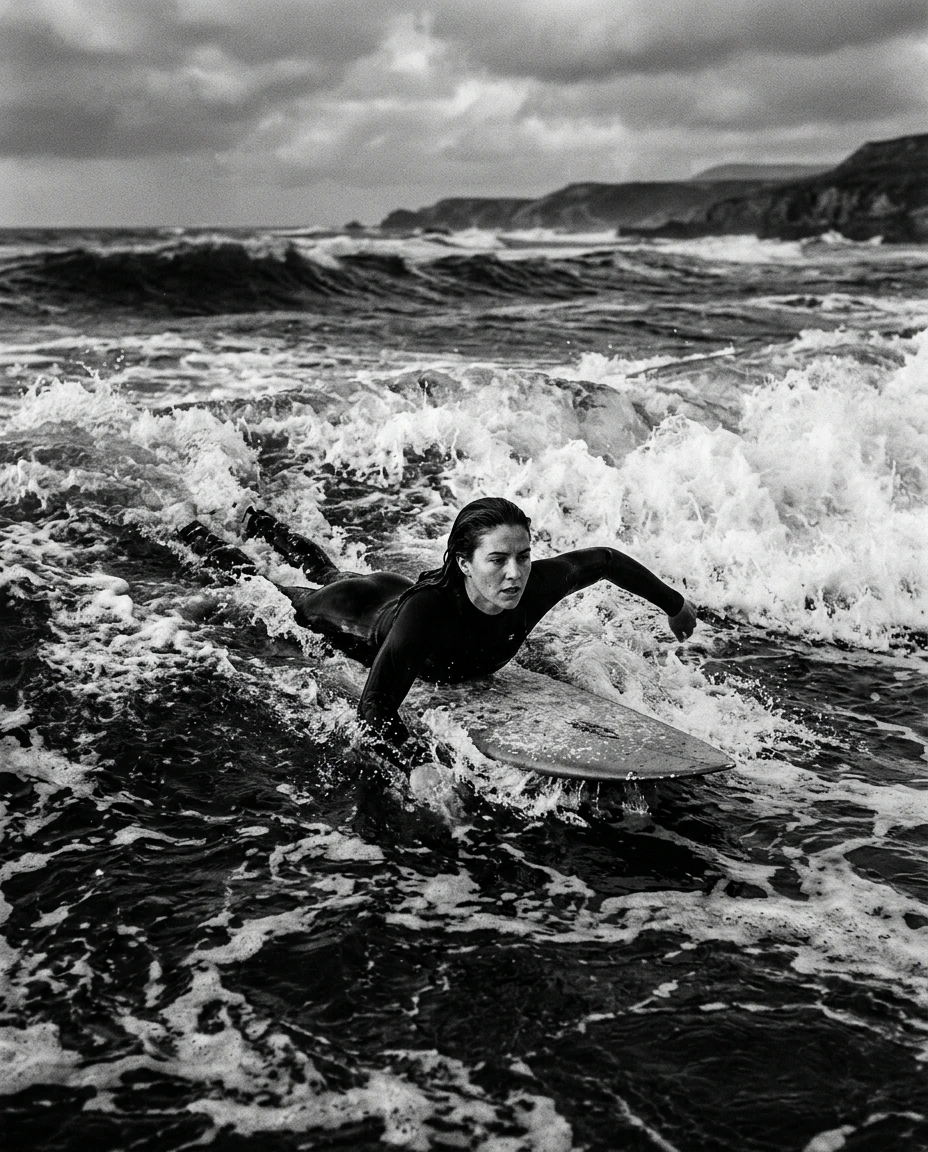
Female surfer paddling out — finding flow in the open ocean
Fight · Flight · Freeze · Fawn
The four responses

How the nervous system says no.

The same four survival programs show up everywhere — in the locker room, on the field, in relationships, and in the way you talk to yourself.

01

Fight.

  • Raging at — and getting into altercations with — teammates, coaches, trainers, and opponents.
  • Irritation with coaches, teammates, opposing teams, fans, and playing conditions.
  • Frustration with coaching, with your own performance, and with everyone else’s.
  • Competition becomes more important everywhere — even competing with your own teammates instead of with them.
  • Determination to the point of losing sight of rules or ethics to reach the goal.
02

Flight.

  • Panic before and during competition, performance, or game time.
  • Fear of playing, getting injured, failing — fixated on the negative outcome.
  • Anxiety inside games and specific sport-specific movements within peak performance.
  • Extremities shaking and moving uncontrollably prior to game time starting.
  • Contemplating quitting the sport — or changing positions or sports altogether.
03

Freeze.

  • Dissociation and decreased neuromuscular ability — numbness and inability to control extremities like the yips and balking.
  • Hesitation, delayed reaction time, and disrupted movement patterns.
  • Death fixation when things aren’t going right, in sport or life — and intrusive suicide ideation.
  • Shame around past or current performance stats and playing abilities.
  • Wide-eyed looking at the coach when commanded — but hesitating to move or follow directives.
04

Fawn.

  • People pleasing and an inability to access who you are or why you’re doing what you’re doing.
  • Always trying to be — or act — perfect to keep others from being upset or disliking you.
  • Denying your own intuition around what you should or shouldn’t do in sport and in life.
  • Hyper-fixated on your parents’, coaches’, or teammates’ reactions to your performance.
  • Not setting boundaries with how others treat you or what you allow within your life.

To fully reset the nervous system and get out of these trauma responses, you have to use Alpha Imprinting to reprocess, reimprint, and desensitize the past low-energy experiences — so you reprogram the system like a computer and regain your optimal energy expression of Alpha flow state.

The four responses · beyond sport

How the nervous system says no. — in the work.

The same four survival programs show up anywhere the pressure is high — in the boardroom, in the OR, on stage, in startups, and in the way CEOs, surgeons, founders, first responders, and creatives talk to themselves and run their lives.

01

Fight.

  • Raging at — and getting into blowups with — partners, employees, vendors, clients, and partners at work.
  • Irritation with your team, board, customers, market conditions, and the pace of every process around you.
  • Frustration with execution, with your own output, and with everyone else’s.
  • Competition bleeds into everything — competing with peers and collaborators instead of leading alongside them.
  • Determination to the point of cutting corners or compromising your own ethics to hit the goal.
02

Flight.

  • Panic before and during pitches, deadlines, board meetings, surgeries, releases, and high-stakes calls.
  • Fear of botching the launch, failing publicly, getting fired, losing the deal — fixated on the negative outcome.
  • Anxiety inside the work itself — heart racing, breath shallow, ruminating on worst-case scenarios.
  • Hands unsteady, voice jitter, insomnia the night before the day that matters.
  • Contemplating walking away from the company, the practice, the role, or the work altogether.
03

Freeze.

  • Dissociation and decreased executive function — brain fog, numbness, indecision in the moments that matter most.
  • Hesitation, delayed response time, and analysis paralysis when the stakes are high.
  • Death fixation when things aren’t going right — intrusive ideation spirals and the dark should-I-still-be-here thoughts.
  • Shame around past decisions, past hires, financial outcomes, and the version of you on paper.
  • Wide-eyed hearing the directive — but hesitating to sign, ship, commit, or take the call.
04

Fawn.

  • People pleasing and an inability to access what you actually want — or why you’re still doing this.
  • Always trying to be — or perform — perfect to keep clients, boards, partners, and audiences from being upset.
  • Denying your own intuition around what you should or shouldn’t ship, hire, fire, sign, or pursue.
  • Hyper-fixated on your investors’, customers’, partners’, or audience’s reactions to every move you make.
  • Not setting boundaries with how people treat you, what lives on your calendar, or what you commit to.

The biology doesn't change. Whether the pressure is a World Cup final, a board meeting, an OR, a release deadline, or a quarter-end number — the same four responses take over. To fully reset the nervous system and get out, you use Alpha Imprinting to reprocess, reimprint, and desensitize the past low-energy experiences — so you reprogram the system and regain your optimal energy expression of Alpha flow state.

How it builds

From the first imprint to the day it runs the show.

Trauma responses don't arrive at the top of your sport — they've been compounding since childhood, quietly shaping every performance reaction you have today.

01
Chapter

Subconscious programming.

By the age of seven, your nervous system is already programmed by your past experiences. That programming — your subconscious — runs up to 97% of your actions and reactions in present reality. If you’ve endured high stress, trauma, or adversity, the programming isn’t optimized. Alpha Imprinting reprograms it back to Alpha flow state.

02
Chapter

Trauma responses develop through adversity.

As a child, your nervous system resets to survival — fawn, freeze, flight, or fight — when you endure negative experiences. Parents fighting or yelling. Death or loss of a loved one or pet. Parents divorcing or moving multiple times. Not getting emotional support when you were hurting. Being denied what you needed as a child. These programs run subconsciously, outside your conscious control, and start to cause mental-health symptoms like anxiety and depression.

03
Chapter

Trauma responses get stronger as you age.

The more negative experiences pile on, the more biochemically intense the response becomes — until big feelings surface from minor incidents. Bike crashes and injuries. Bullying and physical fights. Being criticized or shamed by parents, teachers, or coaches. Doing poorly in school or having learning differences. On top of all this, you start to develop a perfectionist mentality — over-performing to appease and please others. That mentality breaks down performance confidence and undermines your true sense of self and your abilities.

04
Chapter

Trauma responses start to control your life.

As more traumas pile up through your teenage years — break-ups, rejection, pressure at school — habitual resourcing behaviors like drinking and drugs start to be an escape from the hard feelings and the stress it takes to keep pushing on. Between the habitual resourcing and the criticism from others, you start to become hypercritical of yourself and others — which only creates more stress and trauma on your own nervous system. Wanting to perform your best takes discipline. But trying to achieve perfection is simply not obtainable.

05
Chapter

Trauma responses inhibit peak performance.

As you progress in your sport, the pressure to perform increases — and so does the physical toll on your nervous system. Tightened fascia. Restricted range of motion. Slowed reaction time. Inhibited speeds. Uncontrollable muscle movements and hesitations set in. Hesitations turn into mistakes, which start to trigger your “trauma memory network” — subconsciously intensifying your inability to stay in flow and play with ease. You start forcing movement and pushing through pain. Then the overuse and contact injuries pile up — until you’re stuck in a trauma response and playing worse than you practice, with no idea why.

06
Chapter

Trauma responses can no longer be denied.

At this point you’re living within a trauma response — sympathetic nervous system dominance — which means higher levels of stress hormones perpetuating the trauma memory network, inhibiting recovery, and breaking down hard-earned muscle. Physical recovery can only get you so far. There is no way to consciously rationalize or think your way out. The more you analyze and try to figure out how to regain control, the more you solidify and strengthen the trauma response neuropathways. The only way out is to clear the trauma reservoir and reset the nervous system.

The way out

Clear the reservoir. Reimprint the flow.

You can't think your way out of a trauma response — you have to clear it, reset it, desensitize it, and reimprint what's underneath.

01

Clear the trauma responses to regain control.

To fully clear the trauma reservoir, you drop into an altered state of consciousness where the subconscious programming is accessible. Body positions access stored trauma information. Sound clears the reservoir of the trauma memory network online with your practitioner. Reservoir release creates positive endorphins. Eye-gaze integration anchors the sensory experience. You tell the story of each experience as if you’re watching it occur like a movie — integrating sights, sounds, smells, and physical sensations along the way.

02

Reset subconscious programming to Alpha flow.

Through cognitive reprocessing of the past experiences, you access and discharge the held energy associated with the emotions surrounding them — while concurrently reimprinting the maladaptive belief systems that created the subconscious trauma response programming. Then you work the body: sport-specific positions and past positions of injury or traumatic situations — using your own biofeedback so the remaining stored energy is reprocessed, discharged, and reimprinted back to Alpha flow state.

03

Desensitize trauma response potential.

Once the past is cleared, you start desensitizing the nervous system to the potential of any future negative performance outcomes, injuries, or failures — so the next big moment can’t knock you out of Alpha flow. Then you desensitize the environmental and uncontrollable stressors — spectators, weather, negative teammates or coaching staff — so the nervous system won’t shift out of flow when pressure is on at the highest level.

04

Imprint peak performance potential.

Now your nervous system is desensitized to trauma responses — and you imprint the most precise, optimal cognitive outcome while integrating it into the sensory experience alongside sports visualization. Once the best cognitive outcome is imprinted, you imprint the body too — biofeedback plus precise body positions plus visualization — so the programming is reprogrammed cognitively and physically. The result: an unbreakable Alpha flow state subconscious program — and precise performance neural networks ready to perform optimally.

The result: an unbreakable Alpha flow state subconscious program — and precise performance neuro-networks ready to perform optimally under pressure.

See the method
The physics underneath

Why intention can move the needle.

Alpha Imprinting isn't metaphor. The deeper reason the work lands is grounded in a model of reality the U.S. Army put on paper four decades ago — and the CIA later declassified.

“The universe is an energy system composed of interacting electromagnetic fields. Matter is a special case of energy vibrating at particular frequencies. Consciousness is another case, vibrating at higher ones.”
— Paraphrased from McDonnell (1983)1

The implication — stated explicitly in the report — is that consciousness can interact with matter because both are expressions of the same fundamental energy. Intention is an electromagnetic pattern. Properly focused and amplified through hemisphere synchronization, it can influence the structure of physical reality. The document doesn't present this as speculation — it presents it as the logical conclusion of the physics.1

This is the foundation Alpha Imprinting works from. The nervous system isn't separate from the field — it is field. Clearing the reservoir is clearing stored electromagnetic pattern. Reimprinting Alpha flow is re-tuning the frequency. When the inner pattern shifts, what shows up on the field, in the room, and in the body shifts with it.

Citations
  1. 1 McDonnell, W. M. (1983). Analysis and Assessment of the Gateway Process. U.S. Army Operational Group, Intelligence and Security Command. Declassified by the CIA, 2003. Document CIA-RDP96- 00788R001700210016-5.
  2. 2 McCraty, R., Atkinson, M., Tomasino, D., & Bradley, R. T. (2009). The coherent heart: Heart–brain interactions, psychophysiological coherence, and the emergence of system-wide order. Integral Review, 5(2), 10–115.
  3. 3 Doidge, N. (2007). The Brain That Changes Itself. Viking Press.
The results

The results speak before the science does.

Hypnotherapy, breathwork, heart-coherence training, and guided altered states — the modalities behind Alpha Imprinting — consistently produce measurable change, and faster than traditional talk-based methods.

6 sessions
Hypnotherapy

A landmark comparison of therapeutic methods found hypnotherapy resolved presenting issues in an average of 6 sessions — compared to 22 for behavior therapy and 600 for psychoanalysis.4

5 min / day
Breathwork

A Stanford study found that just five minutes a day of structured breathwork produced greater improvements in mood and lower resting arousal than mindfulness meditation over the same period.5

−50% anxiety
Coherence training

Six weeks of heart-coherence training produced a 50% drop in anxiety, 46% drop in fatigue, and significant gains in calm and sleep quality in working adults.6

70%+
Altered states

In Johns Hopkins research on guided altered-state sessions, more than 70% of participants rated a single experience among the most personally meaningful of their lives — with measurable improvements in well-being more than a year later.7

Citations
  1. 4 Barrios, A. A. (1970). Hypnotherapy: A reappraisal. Psychotherapy: Theory, Research & Practice, 7(1), 2–7. Comparative recovery rates across psychoanalysis, behavior therapy, and hypnotherapy.
  2. 5 Balban, M. Y., et al. (2023). Brief structured respiration practices enhance mood and reduce physiological arousal. Cell Reports Medicine, 4(1), 100895. Stanford School of Medicine.
  3. 6 McCraty, R., Atkinson, M., & Tomasino, D. (2003). Impact of a workplace stress reduction program on blood pressure and emotional health in hypertensive employees. Journal of Alternative and Complementary Medicine, 9(3), 355–369.
  4. 7 Griffiths, R. R., Richards, W. A., Johnson, M. W., McCann, U. D., & Jesse, R. (2008). Mystical-type experiences occasioned by psilocybin mediate the attribution of personal meaning and spiritual significance 14 months later. Journal of Psychopharmacology, 22(6), 621–632. Johns Hopkins University School of Medicine.
Case studies

World Cup athletes, before and after.

USA World Cup snowsport athletes — average competition place at National or World Championship events, season over season. Each athlete completed an average of 10–18 Alpha Imprinting sessions. The green star marks the season Alpha Imprinting began.

World Cup Athlete Average Place Finish Per Season

Performance results

510152025151317204
USA Freestyle Mogul Skier — Collar Bone Fracture
05101520253023151499295
USA Downhill Skier — ACL Tear
12345678462675
USA Snowboard Half Pipe Athlete — Shoulder Dislocation
Alpha Imprinting intervention

Lower place number = better finish. Charts read top-down. Individual results; not a guarantee of future outcomes.

Ready

Clear the reservoir. Reset the system.

Tell Dr. Paige where you are, where you're trying to go, and what's in the way. She'll tell you whether 1:1 Alpha Imprinting inside the 10-Week Program — or a team engagement — is the right next move.